
Courage Doesn’t Mean You Aren’t Afraid
There are moments in life when we know we need to move forward, but we aren’t entirely sure what lies ahead.
Perhaps you’re preparing to start a new job, move to an unfamiliar place, make a difficult decision, or begin a new chapter of your life.
Maybe you’re facing a situation you never expected.
A relationship has changed. A source of security has disappeared. A responsibility has become greater than you imagined. Or circumstances beyond your control have forced you to reconsider the future you thought you were building.
During times like these, people often tell us to be strong.
They encourage us to have courage, remain positive, and believe everything will work out.
But those words can be difficult to accept when the uncertainty is real.
How do you become courageous when you don’t know what will happen next?
How do you remain strong when the circumstances surrounding you make you feel vulnerable?
And what does it mean to trust God when you cannot see the outcome?
These questions bring us to Deuteronomy 31:6, one of the Bible’s most recognized passages about courage and God’s faithfulness.
In this verse, Moses encourages the people of Israel as they prepare to enter a land they have never occupied, face enemies they have not yet defeated, and continue their journey without the leader who has guided them for decades.
His message is both a command and a reassurance.
Be strong. Be courageous. Do not be afraid.
But the reason he gives is especially important.
God will go with them.
The passage offers a lesson about courage that remains meaningful today: faith does not always remove uncertainty, but it can change how we face it.
What Does Deuteronomy 31:6 Say?
Deuteronomy 31:6
6 Be strong and courageous. Do not be afraid or terrified because of them, for the Lord your God goes with you; he will never leave you nor forsake you.
This verse contains several connected ideas.
Moses calls the Israelites to be strong and courageous. He tells them not to be terrified of the people they will encounter. And he reminds them that the Lord their God will accompany them and will not abandon them.
The words are encouraging, but they were not spoken during a peaceful or predictable time.
They were delivered during a major transition in Israel’s history.
Understanding that transition helps us appreciate the meaning of the passage.
The Biblical Context: Israel Standing at the Edge of a New Beginning
The book of Deuteronomy records Moses’ final instructions to the people of Israel before they enter the Promised Land.
For approximately forty years, the Israelites had traveled through the wilderness following their departure from Egypt.
During that time, they experienced hardship, uncertainty, rebellion, provision, and repeated opportunities to learn what it meant to trust God.
Now, a new generation was preparing to cross the Jordan River into Canaan.
But their circumstances were changing.
Moses Would Not Be Going With Them
Moses had led Israel out of Egypt, guided the people through the wilderness, delivered God’s law, and served as a central figure in their national and spiritual life.
Yet Moses would not lead them into the Promised Land.
In Deuteronomy 31, he tells the people that he is 120 years old and will not cross the Jordan with them.
Joshua would become their new leader.
Imagine what that transition might have meant for the Israelites.
They had spent years following Moses.
His leadership had become part of their experience of God’s guidance.
Now they were preparing to face unfamiliar territory without him.
The future would require them to trust God while accepting a new leader and confronting new challenges.
The Land Ahead Was Not Empty
The Israelites were not simply moving into an unoccupied region.
The biblical narrative describes established peoples and fortified cities in Canaan.
The Israelites would face resistance and conflict.
Their concerns were not imaginary.
They had practical reasons to feel uncertain about what lay ahead.
Moses did not pretend those challenges were insignificant.
Instead, he reminded the people of God’s covenant faithfulness and encouraged them to move forward.
This historical setting matters because Deuteronomy 31:6 was originally addressed to Israel at a particular moment in its covenant history.
It was not a general promise that every individual would avoid hardship or succeed in every undertaking.
Nevertheless, the passage reveals themes of God’s faithfulness, courage, and trust that Christians continue to find meaningful.
What Does “Be Strong and Courageous” Mean?
The opening instruction is direct.
Be strong and courageous.
At first, these words may sound like a command to become emotionally fearless.
But courage and fear are not opposites in the way we sometimes imagine.
Courage does not necessarily mean that fear disappears.
It means a person is willing to act faithfully despite the presence of fear.
Strength Is Not Always What It Looks Like
We often associate strength with confidence, independence, and the ability to handle difficult situations without assistance.
A strong person, we imagine, always knows what to do.
They remain calm under pressure.
They never doubt their decisions.
They don’t need help.
But real life rarely works that way.
Someone can be strong and still feel overwhelmed.
A person can be courageous while acknowledging uncertainty.
A parent can demonstrate strength by admitting they need guidance.
A leader can show courage by acknowledging a mistake.
Someone facing a difficult season can remain faithful while experiencing grief, anxiety, or exhaustion.
Strength does not require pretending that circumstances are easier than they are.
Sometimes strength begins with acknowledging the difficulty and deciding to respond wisely anyway.
Courage Requires a Direction
Think about a difficult decision you have been postponing.
Perhaps you need to have an uncomfortable conversation.
Maybe you need to acknowledge that a familiar situation is no longer healthy.
Or perhaps you need to pursue a responsibility that feels larger than your current abilities.
You might spend weeks waiting until you feel completely confident.
But confidence does not always arrive before action.
Sometimes it develops as you begin taking responsible steps.
The instruction to be courageous invites us to consider whether fear has become the deciding factor in our choices.
Are we evaluating the situation carefully?
Or are we allowing discomfort alone to determine what we do?
This distinction is important.
Biblical courage is not recklessness.
It does not mean ignoring danger, refusing advice, or making impulsive decisions.
It means remaining willing to do what is right even when doing so requires us to face uncertainty.
What Does “Do Not Be Afraid or Terrified” Mean?
Moses specifically addresses the fear Israel might experience because of the peoples living in the land ahead.
He recognizes that the Israelites are approaching circumstances that could intimidate them.
But he urges them not to allow that fear to overwhelm their confidence in God’s faithfulness.
Fear Can Inform Us Without Controlling Us
Fear is a normal human response to perceived danger or uncertainty.
It can alert us to risks and encourage preparation.
If you are facing a serious financial decision, concern about the consequences may motivate you to examine your options carefully.
If you are entering an unfamiliar environment, caution may help you recognize potential hazards.
If a relationship has become harmful, fear may signal a need for protection or support.
The presence of fear does not automatically indicate a lack of faith.
The deeper question is how we respond to it.
Do we allow fear to inform responsible judgment?
Or do we allow it to become the final authority over our decisions?
When Fear Becomes Avoidance
Imagine someone who has been offered an opportunity to take on greater responsibility at work.
They have the experience and ability to succeed, but they are afraid of making mistakes.
They imagine every possible failure.
What if they disappoint others?
What if they discover they aren’t as capable as people believe?
What if the new responsibility becomes overwhelming?
Eventually, they decline the opportunity.
Not because they carefully determined it was wrong for them, but because the possibility of failure felt unbearable.
Fear has moved from being something they experience to something that governs their decision.
This is one of the ways uncertainty can quietly shape a person’s life.
We may begin organizing our choices around avoiding discomfort rather than pursuing what is meaningful or right.
Deuteronomy 31:6 challenges us to consider whether fear is preventing us from moving forward in faith.
That does not mean every opportunity should be accepted or every risk should be taken.
It means fear deserves examination rather than automatic obedience.
“The Lord Your God Goes With You”: The Foundation of Courage
The most important part of this passage may be the reason Moses gives for Israel’s courage.
The Israelites are not told to be strong simply because they possess extraordinary abilities.
They are not encouraged to believe that their circumstances will be easy.
Their confidence is grounded in the presence and faithfulness of God.
This changes the meaning of the entire instruction.
The people are being called to trust the God who has already guided them through the wilderness.
God’s Presence Does Not Mean the Absence of Difficulty
One common misunderstanding of passages like Deuteronomy 31:6 is the belief that God’s presence guarantees a trouble-free life.
But the Israelites were about to face difficult circumstances.
They would encounter conflict, uncertainty, and responsibilities requiring courage and obedience.
The promise of God’s presence did not eliminate those challenges.
It gave them a reason to remain faithful while confronting them.
For Christians today, this distinction is essential.
Faith does not guarantee that every relationship will be restored.
It does not guarantee that every business venture will succeed.
It does not mean that illness, grief, disappointment, or hardship will never enter our lives.
God’s faithfulness should not be reduced to a promise that circumstances will always unfold according to our preferences.
The biblical message is deeper than that.
Believers can seek God’s guidance, depend on His grace, and remain faithful even when the outcome is uncertain.
What Are You Depending On for Security?
Consider how much of our confidence comes from circumstances we believe we can control.
We may feel secure because we have a stable job.
Because our relationships seem predictable.
Because our health is good.
Because our finances are manageable.
Because we have carefully planned the next several years.
These things can be valuable.
Planning and preparation are wise.
But circumstances change.
A company restructures.
A relationship ends.
A medical diagnosis changes someone’s priorities.
An unexpected responsibility interrupts a carefully designed future.
When our entire sense of security depends on circumstances remaining unchanged, uncertainty can become especially difficult.
Deuteronomy 31:6 invites believers to consider a foundation for trust that is not limited to favorable conditions.
The central reassurance is not that the Israelites can control everything ahead of them.
It is that God will be faithful to His covenant commitment.
“He Will Never Leave You Nor Forsake You”: Understanding God’s Faithfulness
The final words of the passage emphasize that God will not abandon His people.
In the original setting, this reassurance belongs to God’s covenant relationship with Israel as the nation prepares to enter Canaan.
The Israelites are being reminded that Moses’ departure does not mean God’s presence is departing.
Their human leader is changing.
God’s faithfulness is not.
The Difference Between Feeling Alone and Being Abandoned
There are times when people feel deeply alone.
Perhaps you’re facing a problem that others don’t fully understand.
Maybe you’ve experienced disappointment from someone you trusted.
Or perhaps you’re carrying responsibilities that seem invisible to the people around you.
During those moments, it can be difficult to feel supported.
The Christian understanding of God’s presence offers a source of spiritual reassurance.
But this does not mean believers will always experience a strong emotional sense of God’s nearness.
Feelings change.
There may be seasons when prayer feels difficult, answers seem delayed, and circumstances remain unresolved.
The absence of a particular feeling is not necessarily evidence of God’s abandonment.
Christian faith often involves continuing to trust when emotional certainty is limited.
God’s Faithfulness and Human Responsibility
Trusting God does not eliminate our responsibilities.
The Israelites still needed to follow Joshua, cross the Jordan, and respond faithfully to the challenges ahead.
In the same way, modern believers still need to make decisions, seek wisdom, prepare carefully, and take appropriate action.
Prayer does not replace responsibility.
Faith does not eliminate the need for planning.
And trusting God does not mean refusing help from other people.
Sometimes the faithful response to uncertainty involves seeking counsel, developing a plan, asking for assistance, or taking a difficult but necessary step.
The reassurance of God’s presence is not an invitation to become passive.
It is an encouragement to remain faithful while acting responsibly.
The Deeper Lesson: Courage Is Built on Trust, Not Certainty
One of the most meaningful lessons of Deuteronomy 31:6 is the relationship between courage and uncertainty.
We often imagine that courage becomes possible when uncertainty disappears.
If we knew the decision would work out, we would make it.
If we knew the conversation would go well, we would have it.
If we knew the new opportunity would succeed, we would pursue it.
But life rarely provides that level of certainty.
Many important decisions must be made without knowing exactly what will happen.
The Israelites could not see every challenge awaiting them in Canaan.
They did not possess complete knowledge of the future.
Yet they were called to move forward faithfully.
This is an important distinction:
Certainty concerns what we know about the outcome. Courage concerns how we respond when the outcome is not fully known.
For believers, faith can provide a foundation for that response.
Not because every outcome is guaranteed to be favorable.
But because trust in God is not meant to depend entirely on favorable circumstances.
You Can Be Prepared Without Being Certain
Imagine someone preparing to begin a new career.
They have studied, developed skills, sought advice, and considered the responsibilities involved.
Yet they still feel uncertain.
Will they succeed?
Will they make mistakes?
Will they regret the decision?
No amount of preparation can eliminate every possibility of difficulty.
But preparation can make responsible action possible.
The person may still feel afraid on the first day.
They may still question themselves.
Yet they can move forward because they have a reasoned basis for the decision and a willingness to learn.
This is not a perfect parallel to Israel’s covenant experience, but it illustrates a useful principle.
We do not need complete certainty about every outcome before taking a faithful and responsible next step.
What Deuteronomy 31:6 May Reveal About Your Own Life
This passage offers an opportunity to examine how we respond to change, uncertainty, and the possibility of failure.
Are You Waiting Until You Feel Ready?
Think about something important you have been postponing.
Perhaps it is a conversation.
A decision.
A responsibility.
A necessary change.
You may have told yourself that you will act when the timing feels right.
When you have more confidence.
When the uncertainty disappears.
When you are certain that you won’t fail.
But what if those conditions never arrive?
Sometimes waiting is wise.
There are situations in which additional information, preparation, or patience is necessary.
But sometimes waiting becomes a way of avoiding discomfort.
The question worth asking is:
Am I waiting because I need more information, or because I am afraid to act on what I already know?
The answer may reveal something important about the role fear is playing in your decisions.
Have You Confused Strength With Independence?
Many people learn to associate strength with handling everything themselves.
They become uncomfortable asking for help.
They avoid admitting uncertainty.
They believe that needing support means they are failing.
But consider the biblical story surrounding this passage.
Israel was not called to rely on individual independence.
The people were called to follow God’s guidance within a community, under the leadership of Joshua.
Their strength was not defined by the absence of dependence.
It was connected to trusting God and responding faithfully together.
There may be an important lesson here for someone who has been carrying too much alone.
Asking for help does not automatically mean you lack courage.
Acknowledging a limitation does not make you weak.
Sometimes the courageous choice is admitting that you need wisdom, support, or guidance.
Are You Trying to Control an Uncontrollable Future?
Uncertainty can create a strong desire for control.
We want to know what will happen.
We want to prevent disappointment.
We want assurances that our efforts will produce the outcomes we desire.
But much of life remains outside our control.
We cannot control every decision another person makes.
We cannot prevent every unexpected event.
We cannot guarantee that every carefully prepared plan will succeed.
What we can often influence is our response.
We can prepare responsibly.
We can make thoughtful decisions.
We can act with integrity.
We can seek guidance.
We can remain faithful to our responsibilities.
And we can learn to distinguish what belongs to us from what does not.
For Christians, trusting God includes recognizing the limits of human control without abandoning personal responsibility.
Applying Deuteronomy 31:6 to Everyday Life
How might this passage influence the way we approach real challenges?
1. Acknowledge the Fear Instead of Pretending It Isn’t There
You do not have to deny your feelings to respond courageously.
If a situation is frightening, acknowledge it.
Consider what specifically concerns you.
Is there a genuine danger?
Are you uncertain about your ability?
Are you worried about disappointing someone?
Are you imagining the worst possible outcome?
Identifying the source of fear can help you respond thoughtfully.
2. Separate What You Can Control From What You Cannot
When facing uncertainty, consider two questions.
What is within my responsibility?
What lies beyond my control?
You may be able to prepare, communicate honestly, seek counsel, and make a wise decision.
You may not be able to determine how every person responds or guarantee the final outcome.
This distinction can help you direct your energy toward faithful action rather than endless worry.
3. Remember How You Have Been Sustained Before
Moses’ encouragement was grounded in Israel’s history with God.
The people had experienced His provision throughout the wilderness.
Christians can similarly reflect on previous seasons of difficulty, answered prayers, unexpected support, and lessons learned through hardship.
This reflection does not guarantee that future circumstances will unfold in the same way.
But remembering past experiences can encourage gratitude, perspective, and continued trust.
4. Take the Next Responsible Step
You may not know how an entire situation will unfold.
But you may know what needs to happen next.
Perhaps you need to make a phone call.
Seek professional advice.
Have a difficult conversation.
Complete an application.
Apologize.
Ask for help.
Or begin preparing for a necessary transition.
You don’t always need a complete picture of the future to take one thoughtful step in the present.
5. Let Faith Influence Your Response, Not Just Your Expectations
Sometimes people approach faith primarily as a way of hoping circumstances will improve.
And hope is meaningful.
But faith can also shape how we respond when circumstances remain difficult.
It can encourage patience when answers are delayed.
Integrity when shortcuts are tempting.
Compassion when relationships become strained.
Perseverance when progress is slow.
And humility when we discover that our plans need to change.
In this way, courage becomes more than a feeling.
It becomes part of how we choose to live.
Common Questions About Deuteronomy 31:6
What Is the Main Message of Deuteronomy 31:6?
The central message is that Israel should face the challenges ahead with courage because the Lord will remain faithful to His people.
For Christians, the passage also offers a broader lesson about trusting God rather than allowing fear to determine every response to uncertainty.
Does “Be Strong and Courageous” Mean Christians Should Never Feel Fear?
No.
The command encourages courage in the face of threatening circumstances. It does not establish that every experience of fear is sinful or evidence of weak faith.
Courage can involve acting wisely and faithfully while still experiencing fear.
Does God Promise That Nothing Bad Will Happen?
No.
Deuteronomy 31:6 does not promise a life without hardship.
Its original reassurance concerns God’s presence and faithfulness to Israel as the people enter the Promised Land.
Christians should not interpret the passage as a guarantee that every personal plan will succeed or every difficulty will disappear.
How Can I Apply Deuteronomy 31:6 Today?
You can apply its principles by approaching uncertainty with prayer, responsible preparation, wise counsel, and trust in God’s faithfulness.
The passage can encourage you to resist allowing fear alone to govern your decisions while recognizing that courage does not require recklessness.
Why Did Moses Tell Israel to Be Courageous?
The Israelites were preparing to enter Canaan, face established peoples, and continue under Joshua’s leadership after Moses’ departure.
They were approaching a major national transition, and Moses wanted them to remember God’s covenant faithfulness.
Related Scriptures That Deepen the Teaching
Several other passages help illuminate the biblical themes of courage, trust, and God’s presence.
Joshua 1:9 — Courage During a New Responsibility
9 Have I not commanded you? Be strong and courageous. Do not be frightened, and do not be dismayed, for the Lord your God is with you wherever you go.”
God’s instruction to Joshua echoes the encouragement Moses gave Israel.
Joshua was preparing to assume leadership and guide the people into the Promised Land.
The connection highlights the importance of trusting God’s presence during significant responsibility and change.
Isaiah 41:10 — Strength and Divine Help
10 So do not fear, for I am with you; do not be dismayed, for I am your God. I will strengthen you and help you; I will uphold you with my righteous right hand. Scripture Block
This passage reassures God’s people of His sustaining presence.
Although it comes from a different historical setting, it shares the theme of divine faithfulness amid fear and uncertainty.
Psalm 23:4 — Confidence in Difficult Places
4 Even though I walk through the valley of the shadow of death, I will fear no evil, for you are with me; your rod and your staff, they comfort me.
Psalm 23 portrays God’s presence as a source of comfort even in dangerous or frightening circumstances.
The imagery reinforces the distinction between God’s presence and the absence of hardship.
Philippians 4:6–7 — Responding to Anxiety Through Prayer
6 do not be anxious about anything, but in everything by prayer and supplication with thanksgiving let your requests be made known to God.
7 And the peace of God, which surpasses all understanding, will guard your hearts and your minds in Christ Jesus.
Paul encourages believers to bring their concerns to God through prayer and thanksgiving.
The passage offers a complementary New Testament perspective on responding to worry and seeking God’s peace.
Together, these scriptures encourage believers to approach uncertainty with trust, prayer, wisdom, and faithful action.
Personal Reflection: What Would Courage Look Like in Your Life?
Take a moment to consider these questions.
1. What uncertainty are you currently facing?
Is your concern connected to something you can influence, or to an outcome beyond your control?
2. Is there an important decision you have been postponing because you are afraid of what might happen?
What additional information or preparation would help you make that decision responsibly?
3. When you think about being strong, do you imagine someone who never needs help?
How might your understanding of strength change if you included humility, honesty, and the willingness to seek support?
4. What past experience reminds you that you have been able to endure difficult circumstances?
What did you learn about faith, preparation, community, or perseverance?
5. What is one faithful and responsible step you can take this week, even if you cannot predict the outcome?
You do not need to answer every question immediately.
Sometimes meaningful reflection begins by recognizing which question deserves more attention.
Keeping God’s Word Close: A Reminder to Be Strong and Courageous
The words of Deuteronomy 31:6 can be especially meaningful during seasons of transition.
A new career.
A graduation.
A move.
A difficult responsibility.
A period of uncertainty.
Or simply a time when someone needs encouragement to keep moving forward.
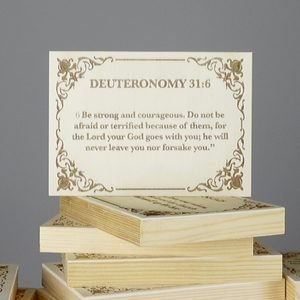
The Deuteronomy 31:6 engraved Scripture Block offers a visible reminder of God’s faithfulness and the call to courage.
Displayed on a desk, bookshelf, nightstand, or personal prayer table, the passage can encourage someone to remember that uncertainty does not have to prevent faithful action.
It can also make a thoughtful Christian gift for a graduate, friend, family member, or loved one preparing for a new chapter.
The purpose is not to suggest that a physical object creates courage or guarantees protection.
Its value is in the message it helps keep close.
A reminder to trust God.
To remain faithful.
To approach uncertainty with wisdom.
And to take the next responsible step even when the entire path is not visible.
The wood is the medium. God’s Word is the message.
Final Reflection: You Don’t Have to Know Everything That Comes Next
There is a reason Deuteronomy 31:6 continues to encourage believers.
It speaks to a challenge that every generation experiences.
We want certainty.
We want security.
We want to know that the decisions we make will lead to the outcomes we hope for.
But life does not always provide those assurances.
The Israelites stood at the edge of a new beginning without knowing every challenge they would face.
Their familiar leader would not accompany them.
Their circumstances were changing.
And the future required courage.
Moses did not tell them that the journey would be easy.
He reminded them that God would remain faithful.
For Christians today, the passage offers a meaningful invitation to examine where confidence comes from.
If courage depends entirely on knowing the outcome, uncertainty will always have the power to stop us.
But when courage is grounded in trust, wisdom, and faithfulness, we can begin moving forward without pretending to know everything ahead.
We can prepare carefully.
We can acknowledge our fears.
We can seek help when we need it.
We can make thoughtful decisions.
And we can trust God while accepting that some outcomes remain beyond our control.
Being courageous does not mean you can see the entire road ahead.
Sometimes it means being willing to take the next faithful step, even when you cannot see where the road will eventually lead.